Are all thicknesses compatible with every color for BILKA LT45 Zinc Profiled Sheet Metal in a project for a single-pitch canopy with a visible underside?
BILKA LT45 Zinc Profiled Sheet Metal is not a single stock item but a group of 6 variants. Thicknesses: 0.5 mm, 0.45 mm, 0.4 mm, 0.6 mm, 0.7 mm, or 0.37 mm; colors: Zinc; there is no separate configuration option. For example, 0.5 mm / Zinc is SKU LT-2157, and 0.37 mm / Zinc is SKU LT-2160. Only the listed combinations are valid. The 0.37 mm thickness is recorded in Shopify but is below BILKA’s 0.40-1.00 mm range and requires confirmation. For a single-pitch canopy with a visible underside, the selected variant must be fully specified in the order.
How is the steel base of BILKA LT45 Zinc Profiled Sheet Metal protected in a project for a warehouse building with long roof slopes?
For BILKA LT45 Zinc Profiled Sheet Metal, the protection is the galvanized steel base without a selected RAL color. The official category for this finish is a 2-year compliance warranty according to BILKA’s published condition for galvanized products without color. The geometry remains that of T45: 45 mm height and 980 mm effective width. Long slopes are only divided after checking transport, water flow, and allowable transverse connections. For critical color nuances, the color is chosen from a physical sample catalog because screens may reproduce it differently.
What is the minimum slope specified for BILKA LT45 Zinc Profiled Sheet Metal in a project for a facade strip between finished metal columns?
For the T45 profile, the limit is 8° without diagonal joints and 14° when they are necessary. These values do not prove load-bearing capacity or determine the spacing between supports. BILKA allows T45 for intermediate floors as well, but this product record does not include tables for spans, loads, or supports; such an application requires a structural design. Each span between columns is measured separately, and the final sheet is sized after choosing the overlap. Snow, wind, fasteners, and water flow are checked in the design.
How are the lengths and configuration of BILKA LT45 Zinc Profiled Sheet planned in a project for an agricultural building with natural ventilation?
For the unpainted BILKA LT45 Zinc Profiled Sheet, thicknesses and zinc surface are specified, without a separate membrane option. In the case of T45, the condensation solution also depends on whether the sheet is a covering or part of a structural floor detail. It is not assumed that a membrane is included by default. Moisture from indoor activities is considered together with air exchange, not only by choosing a metal sheet. Before production, the application, lengths from 0.50 to 13.50 m, orientation, substructure, and fastening scheme are defined.
Is BILKA LT45 Zinc Profiled Sheet a roofing, facade, or structural sheet in a roof renovation project with unknown old joints?
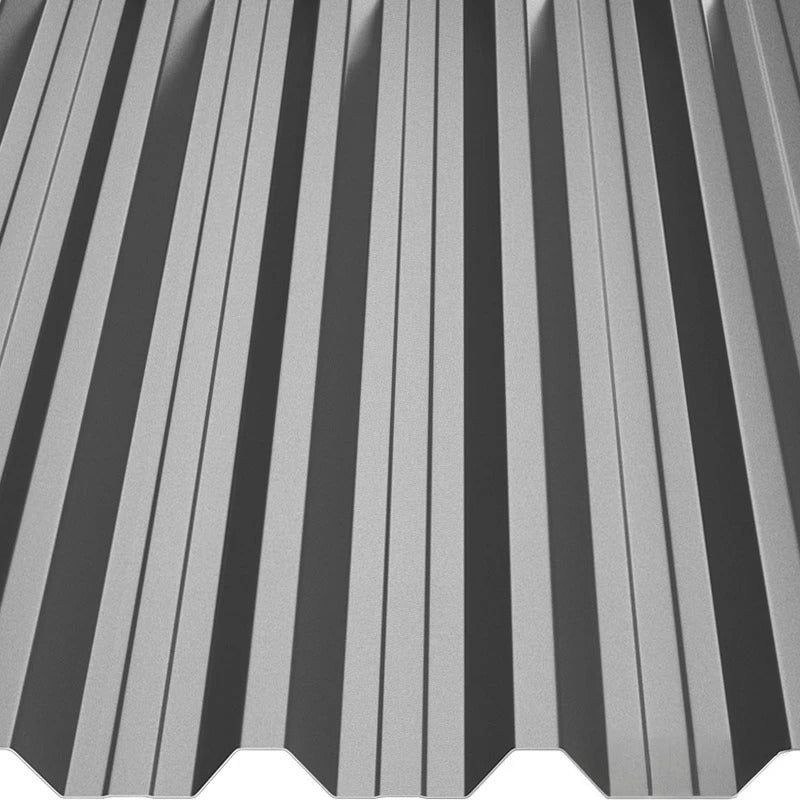
BILKA LT45 Zinc Profiled Sheet is a sheet material with a 45-millimeter profile and a useful width of 980 mm. The manufacturer recommends it for low-slope roofs and intermediate floors in industrial, commercial, and agricultural buildings. The distinctive geometry is a 45-millimeter profile with a useful width of 980 mm, and the zinc finish does not change the profile dimensions. Existing transverse joints are opened and measured; their hidden position should not be assumed from a photo. Before ordering, it is clarified whether the sheet will function as a covering, cladding, or part of a structural detail.
What is the side overlap width for BILKA LT45 Zinc Profiled Sheet in a project for an agricultural building with a risk of internal condensation?
BILKA LT45 Zinc Profiled Sheet has a total width of 1010 mm and a useful roofing width of 980 mm. The overlapped 30 mm is not counted twice; 8 properly joined sheets provide 7.84 m of useful width before final adjustments. The profile height is 45 mm, and the weight according to BILKA is 3–12.5 kg/m². Sources of moisture, air intake and exhaust, and heating regime are described before choosing an anti-condensation solution. For an actual order, all fields are measured because a total area alone does not determine the number and lengths.